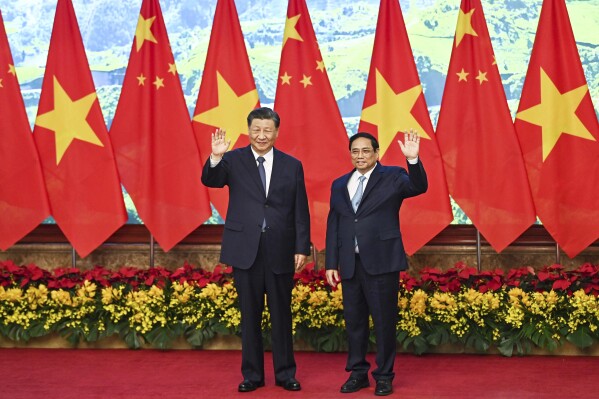
Image Credit: Nhac Nguyen / Pool Photo via AP
Summary
- China has intensified diplomatic engagement with Southeast Asia, aiming to bolster regional alliances amid escalating trade tensions with the U.S., viewing the region as a strategic hedge for economic and security interests.
- In response, the U.S. may need to boost investment and engagement in Southeast Asia and solidify ties with neighbors like Canada and Mexico.
Chinese Engagement in Southeast Asia
Throughout April, Chinese government leaders have upped their engagement with counterparts throughout Southeast Asia. President Xi Jinping completed a five-day diplomatic tour of Southeast Asia, visiting Vietnam, Malaysia, and Cambodia. Furthermore, China and Indonesia held their first ministerial-level 2+2 dialogue in Beijing on April 21, during which the two sides signed an MoU establishing a comprehensive strategic dialogue and agreed to cooperate on defense and maritime security.
China maintains strong relationships with countries in the region — notably, China is both Vietnam’s and Malaysia’s largest trading partner — but Beijing’s interests in the South China Sea have also been the source of tension with the region. Most recently, China Coast Guard (CCG) warned the Philippines to stop so-called “infringements” of China’s land interests.
Can Southeast Asia help China win the Trade War?
While China has many interests in Southeast Asia — and, therefore, many reasons to shore up relationships with its neighboring regional countries — the timing and broader context of Beijing’s renewed push in the region cannot be ignored. China’s trade war with the U.S. is entering a more structured and strategic phase, with conditional trade talks and more targeted pressures on individual firms and resources. As part of this more strategic phase, Beijing is likely also seeking to strengthen regional relationships as a hedge against further trade turbulence with the U.S. National security and domestic production are paramount for Beijing, so it is likely that Chinese leadership views Southeast Asia as a region it can leverage to defend itself and its interests from the U.S.
Implications for the U.S.
- U.S. Policy Implications
As China continues to work more closely with its regional partners, the U.S. could follow a multi-pronged approach to support its competitive advantage in the region. First, American foreign policy-makers could seek to increase investment and engagement in Southeast Asia to challenge the spread of China’s influence in the region (notwithstanding Beijing’s existing positional strength). Second, U.S. policy-makers could seek to shore up regional ties of their own with Canada and Mexico. Given the ongoing trade war, that latter pathway may be challenged, but it is important for the U.S. to have strong allies in its own backyard in order to keep pace with China.
- U.S. Business Implications
Given the already strong economic and financial relationships that exist between China and its regional Southeast Asian partners, deepened engagement from China could be an opportunity for U.S. businesses to shore up their supply chains.
- U.S. Consumer Implications
For American consumers, Beijing’s increased engagement with Southeast Asia could signal further distancing between the U.S. and China, which in turn would mean fewer goods and services trade between the two countries. The prices of common goods and services may increase, so American consumers could consider planning accordingly.

 Sino Strategies: China's Influence & its Implications for the U.S.
Leave a reply to China Publishes First National Security White Paper – Sino Strategies: China's Influence & its Implications for the U.S. Cancel reply